7 Signs You May Have Hidden Mold in Your Walla Walla Home
You keep catching a musty smell in one room and you can't find the source. Or a leak got fixed two years ago and something still doesn't seem right. Suspecting hidden mold in your home here in Walla Walla is frustrating precisely because there's nothing to point at. No dark patch on the wall, no obvious damage, just a feeling that something is off.
That's a normal situation, and it doesn't automatically mean you have a mold problem. It does mean it's worth understanding where mold tends to hide, what signs are worth paying attention to, and what your options are for finding out. This article walks through all three.
Can Mold Be Hidden Inside a Home?
Yes. According to the U.S. Environmental Protection Agency, mold needs moisture to grow, and it will grow on whatever organic material is available: drywall paper, wood framing, insulation backing, carpet padding. None of those places are visible during normal life in a house.
The EPA specifically notes that mold may be growing in hidden areas including the back side of drywall and wallpaper, the underside of carpets and pads, the top side of ceiling tiles, and inside wall cavities around pipes. The Washington State Department of Health makes a related point that matters for older housing: where water has gotten into a building assembly, the moisture and any resulting growth may not appear on the surface for a long time, if at all.
So the absence of visible mold isn't evidence of absence. It usually just means you haven't looked in the place where it is, and in most homes, that place isn't accessible to look at.
The 7 Signs Worth Paying Attention To
None of these signs proves that mold is present. Each one is a reason to look more carefully.
1. A persistent musty odor you can't trace
This is the most common reason people start searching. Mold growth produces odor compounds that travel through wall cavities, floor assemblies, and ductwork, which means the smell often shows up in a room some distance from the actual growth. If a musty smell is strongest in a closet, near a floor register, or on humid days, that pattern is information. Write down where and when you notice it.
2. A past leak, flood, or roof problem
The EPA's guidance is that wet materials should be dried within 24 to 48 hours to prevent mold growth. Plenty of real-world leaks aren't discovered that fast: a slow supply line behind a vanity, a roof leak that only shows during a specific wind direction, a water heater that wept for weeks. If materials stayed wet longer than that window and were never opened up and dried, growth in the cavity is a genuine possibility.
3. Discoloration or staining on walls or ceilings
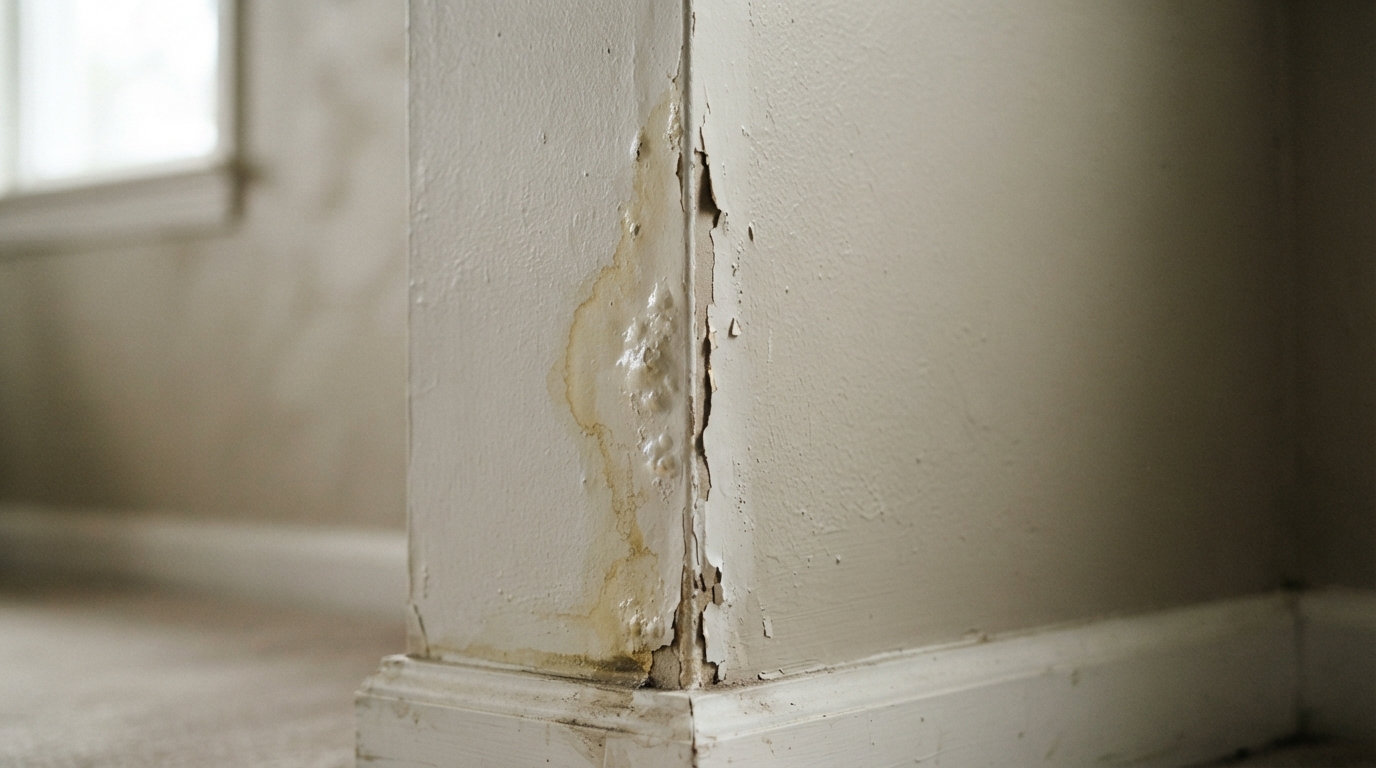
Shadowy patches, yellow-brown tide lines, or a spot that keeps reappearing after you paint over it are all signs that moisture has moved through the material. The stain itself is usually water damage rather than mold, but it marks the spot where water went, and that's where you'd want to look.
4. Peeling paint, bubbling, warping, or soft spots
Building materials distort when they absorb moisture. Bubbling paint, seams opening in drywall, flooring that cups or lifts at the edges, and baseboard that's soft when you press it are all structural symptoms of a moisture source that may still be active.
5. Ongoing condensation or dampness
Windows that sweat through the season, a bathroom that stays damp long after a shower, a crawl space that feels humid, cold-side condensation on ductwork or supply lines. Sustained moisture is the precondition for growth; where it's persistent, it's worth knowing whether growth followed.
6. Visible mold that returns after you clean it
If you wipe down a spot and it comes back in the same place, cleaning isn't reaching the problem. That pattern usually means either the moisture source is still active, or the visible spot is the exposed edge of growth that continues behind the surface.
7. Symptoms or concerns you can't explain (treated carefully)
The Centers for Disease Control and Prevention notes that exposure to damp and moldy environments can cause symptoms such as nasal stuffiness, throat irritation, coughing, and eye or skin irritation in some people, and that people with asthma or mold allergies may have stronger reactions. That's general guidance about damp environments, not a diagnostic test. Symptoms cannot tell you that mold is present, and we can't tell you what's causing yours. That's a conversation for your physician. What symptoms can reasonably do is prompt you to check whether your home has a moisture problem.
Where Hidden Mold Commonly Develops
In practical terms, the places worth suspecting are the places where water goes and air doesn't:
- •Inside wall cavities, especially around plumbing penetrations, tub and shower surrounds, and exterior wall corners
- •Under flooring: beneath vinyl, laminate, and engineered wood, where a subfloor can stay wet under a sealed surface
- •Under carpet and pad, which hold moisture long after the surface feels dry
- •Crawl spaces and beneath cabinets, where a slow leak can run for months unseen
- •Behind and above ceilings below a roof leak, chimney flashing, or upstairs bathroom
- •Around HVAC components and duct runs, where condensation collects on cold surfaces
Why Hidden Mold Is Hard to Find
A visual inspection can only assess what's visible. That's not a knock on home inspectors. A good one will identify moisture indicators, flag stains, and often use a moisture meter or thermal imaging, which are genuinely useful tools. But moisture meters and thermal cameras find water, not mold. They tell you a material is wet or a temperature is anomalous; they don't tell you whether growth has started inside the assembly.
The honest version of the problem is this: confirming hidden mold visually means opening something up. Nobody wants to cut into three walls to find out which one it's behind, and often you shouldn't have to.
How Professional Mold Detection Helps
The useful goal isn't "find out if there's mold somewhere in the house." It's narrow the search so that any invasive work is done in one place instead of five, and so that you know whether invasive work is warranted at all.
That's the point at which a professional inspection earns its cost. If you have one obvious wet spot under a sink and a leak you already fixed last week, you may not need an inspection. You may just need to dry it properly. Where an inspection pays off is when the source is genuinely unclear.
How K9 Mold Detection Works
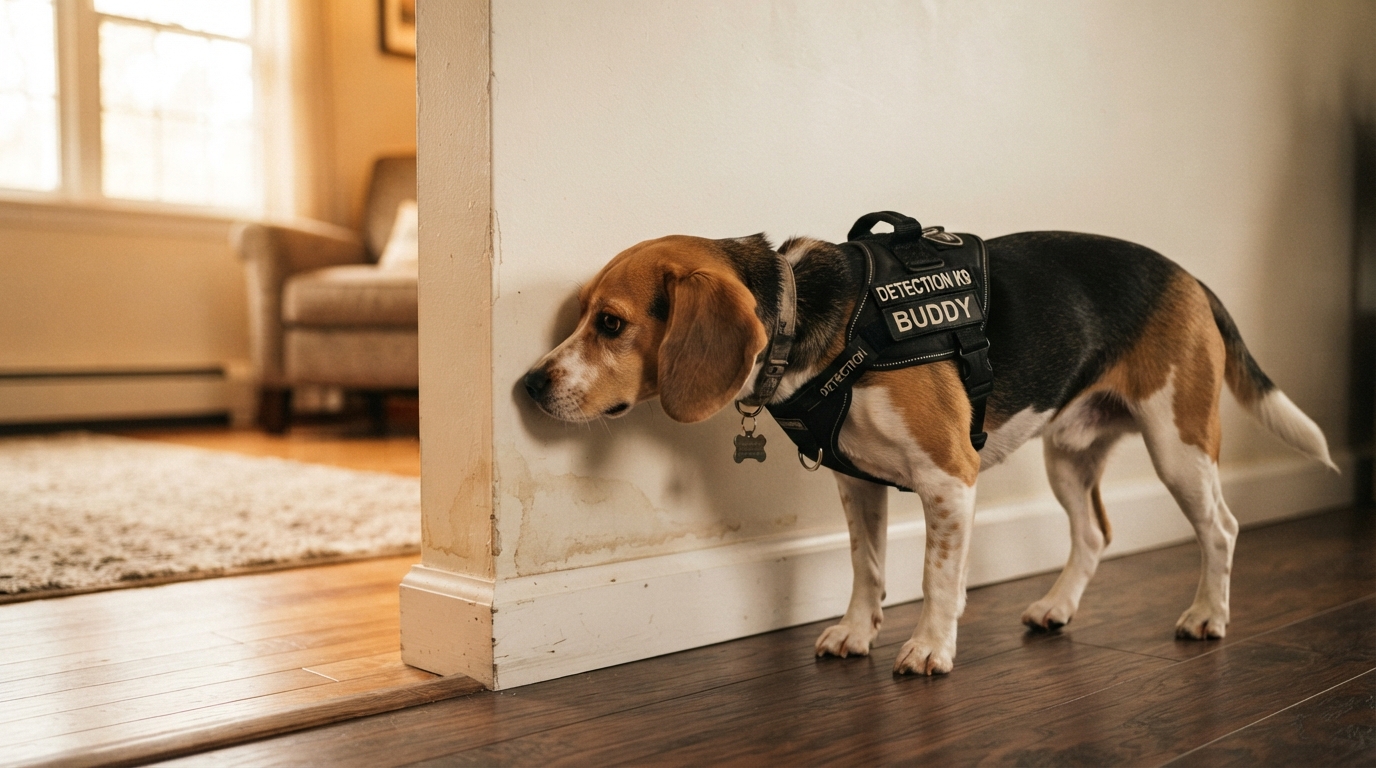
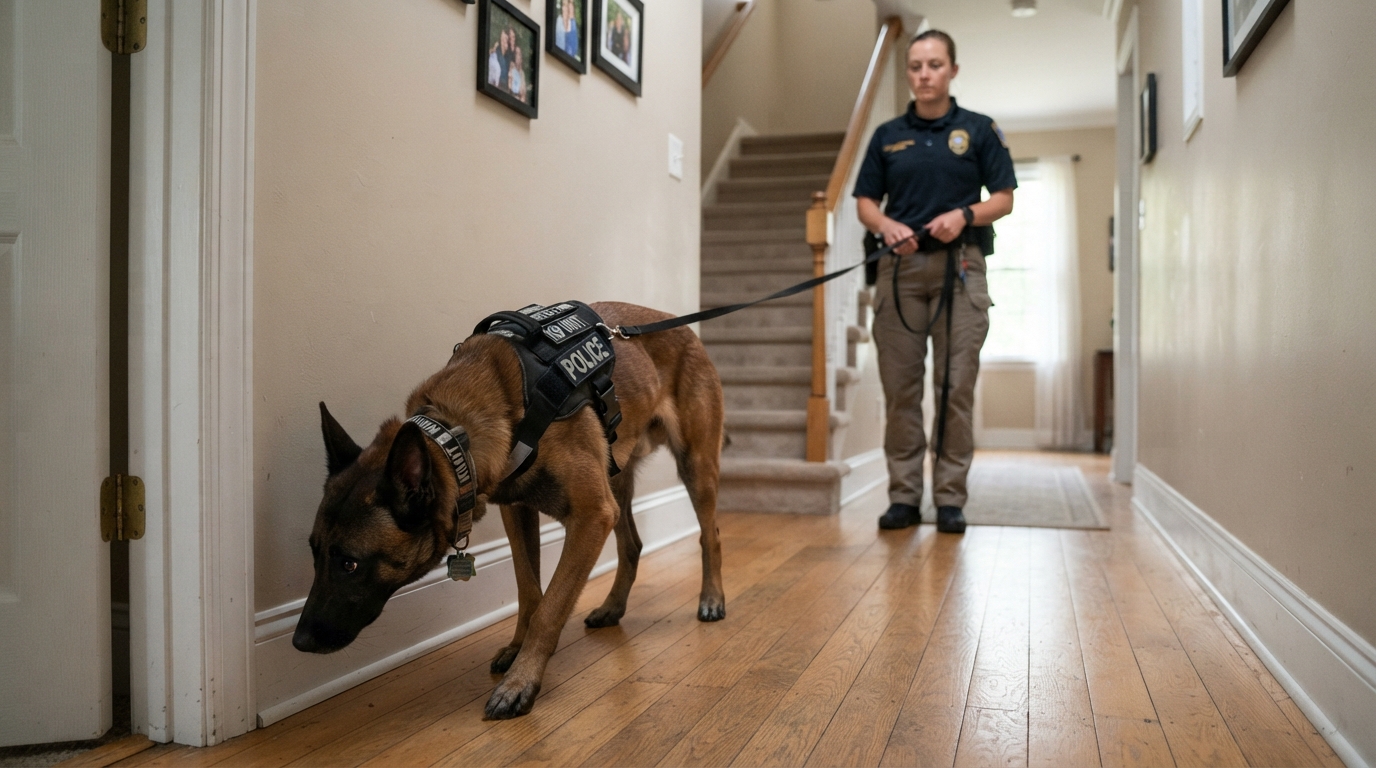
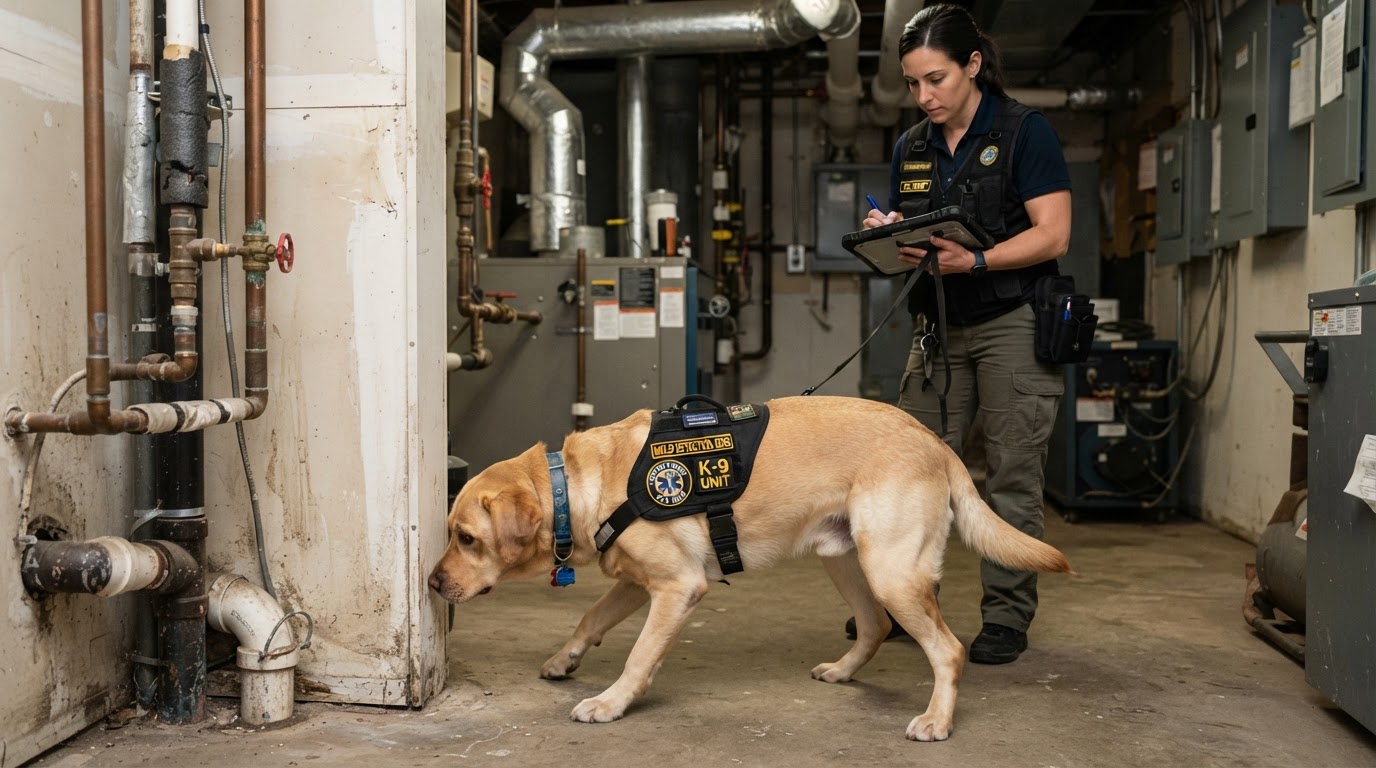
Canine Scent Inspections uses trained detection dogs, Snow and Otis, to help identify where the scent of mold growth is coming from. A dog works the perimeter of a room and alerts at the location where scent is strongest, which can indicate growth inside a wall cavity, under flooring, or in another concealed area a person can't see into without opening it.
Two limits are worth stating plainly. A canine alert indicates the presence of mold odor at a location; it does not identify what species is present or how much. That requires laboratory analysis of a sample. And no inspection method is perfect. An alert is a strong indicator of where to investigate further, not a final answer.
What canine detection is unusually good at is the specific problem in this article: reducing a whole-house question to a specific square footage. It's also not something you'll find from a conventional inspector in this region. K9 mold detection services are not offered by other inspection companies in the Walla Walla Valley.
Not sure what you're smelling? Schedule a mold inspection and find out where it's coming from before you open a wall.
What Happens If Potential Mold Is Located
Detection and remediation are two different services, and it matters that they're kept separate.
Canine Scent Inspections performs inspection and detection only. It does not perform mold removal. That means there's no financial reason to find mold in your home. An inspection can just as easily conclude that no mold was detected in the areas inspected, and that's a legitimate result to pay for.
The process runs: inspection of the property, documented findings and a report of what was inspected and what was found, recommended next steps, and, where removal is warranted, a referral to independent remediation professionals. If you later want to confirm that remediation achieved what it was supposed to, post-remediation verification is a separate service. You can learn more about mold detection dogs and how an inspection is structured before booking anything.
When Walla Walla Homeowners Should Consider an Inspection
Worth considering if any of these apply:
- •A leak, appliance failure, or flooding event where materials stayed wet more than a day or two
- •A musty odor that persists after cleaning and ventilating
- •Buying a home, particularly an older one, where the general inspection flagged moisture
- •Preparing to list, and you'd rather not find out about a problem during the buyer's inspection
- •Previous remediation you want independently verified
- •A recurring moisture problem you've never fully solved
- •Visible mold that keeps returning in the same place
Local Context: Walla Walla Valley Homes
Walla Walla's housing stock spans a wide range of construction eras, from older homes near the downtown core to newer builds on the edges of town, and the age and construction method of a house changes where moisture is likely to get trapped. Older homes are more likely to have crawl spaces, plaster assemblies, and plumbing that's been modified several times over decades; newer, tighter construction traps moisture differently, with less incidental air movement to dry a wet assembly. Research confirms that Walla Walla has mixed-age housing stock spanning historic late-19th- and early-20th-century neighborhoods, mid-century and postwar development, and newer construction. No authoritative local dataset was found showing that crawl spaces are more common than basements. Climate data support cooler, wetter winters and hot, comparatively dry summers, while an irrigation-specific indoor mold risk was not established by reliable public sources.
Service covers Walla Walla and the surrounding Tier 1 communities, including College Place, Milton-Freewater just across the Oregon line, Waitsburg, and Dayton, with regional coverage extending to the Tri-Cities. Canine Scent Inspections states that it is based in Walla Walla and serves clients nationwide. The first 30 miles of travel are free; beyond that, published travel fees are $0.75 per mile in Washington and $1.00 per mile out of state. The website does not publicly define College Place, Milton-Freewater, Waitsburg, and Dayton as an official "Tier 1" service-area group.
Professional K9 Mold Detection in Walla Walla
If you've read this far, you probably have at least one of the seven signs and no clear answer. Canine Scent Inspections provides residential mold detection throughout Walla Walla County and Eastern Washington. It's an inspection designed to tell you where to look, or to tell you that nothing was detected in the areas inspected.
Either answer is better than continuing to wonder.
Schedule a mold inspection. Or, if you're not sure whether your address is in the service area, ask before you book.
*Sources: U.S. EPA: Mold | CDC: Mold | WA State Dept. of Health: Mold*
Frequently Asked Questions
Suspect Mold in Your Home or Property?
Schedule a non-invasive canine mold inspection with our K9 handlers today. Serving Walla Walla and Eastern Washington.
Related Articles
Mold Inspection for Property Managers: A Practical Checklist
Mold inspection for property managers, as a checklist: seasonal checks, tenant complaint steps, and when scheduled monitoring is worth it.
Which Mold Test Do You Need? Surface, Air, and Mycotoxin Testing Compared
Which mold test do you need? Compare surface testing, air sampling, and building mycotoxin testing, and learn when testing is not necessary.