
How Often Should You Get a Mold Inspection?
Most people never think about a mold inspection until something forces the question. A smell in the hallway that comes and goes. A tenant email. A supply line that let go while nobody was home. Then the question becomes urgent, and right behind it comes a second one that is harder to answer: is this a thing you do once, or is this a thing you are supposed to be doing on a schedule?
So how often should you get a mold inspection? For most properties, the honest answer is that there is no calendar rule worth following, because mold does not run on a calendar. It runs on moisture. The right schedule is the one that matches how much water risk your building actually carries and how quickly you would find out if something went wrong.
Here is a practical way to decide, and an honest account of when you do not need us at all.
The Trigger Matters More Than the Interval
The EPA puts the whole problem in one sentence in its brief guide to mold and moisture: "The key to mold control is moisture control." That is why a fixed annual visit is a weak plan for a building with a known water problem and an expensive plan for a building with none.
Start with triggers instead. Schedule an inspection when one of these happens, regardless of when the last one was:
- •Water got somewhere it should not have been and stayed there. The EPA notes that if wet materials are dried within 24 to 48 hours, in most cases mold will not grow. Past that window, you are no longer guessing about risk.
- •Somebody smells something and nobody can find it.
- •A tenant, guest, or family member raises a concern in writing.
- •You are about to buy, sell, or take over management of the building.
- •Remediation was done and you want independent confirmation of the result.
- •The building sat closed and unconditioned for a season.
If none of those apply and the building has no history, a routine inspection is a reasonable comfort purchase, not a necessity. We would rather tell you that than sell you a visit you do not need.
How Often Should You Get a Mold Inspection, by Property Type
With triggers covered, here is where a recurring interval genuinely earns its cost.
Owner-occupied homes with no water history. You live there. You will notice a smell or a stain long before a scheduled inspector would. Inspect on triggers, not on a schedule.
Homes with a water history, a crawl space you never enter, or a finished basement. Annually is reasonable. The parts of a house that hide problems are the parts nobody walks through.
Rentals and long-term tenanted properties. Annually, ideally at turnover. Turnover is the one moment the unit is empty, accessible, and between occupants, which makes it the cheapest inspection you will ever schedule and the one most likely to prevent a dispute.
Short-term rentals and vacation properties. Quarterly, or seasonally around the shoulder months when the property sits empty. Unoccupied buildings do not report their own leaks.
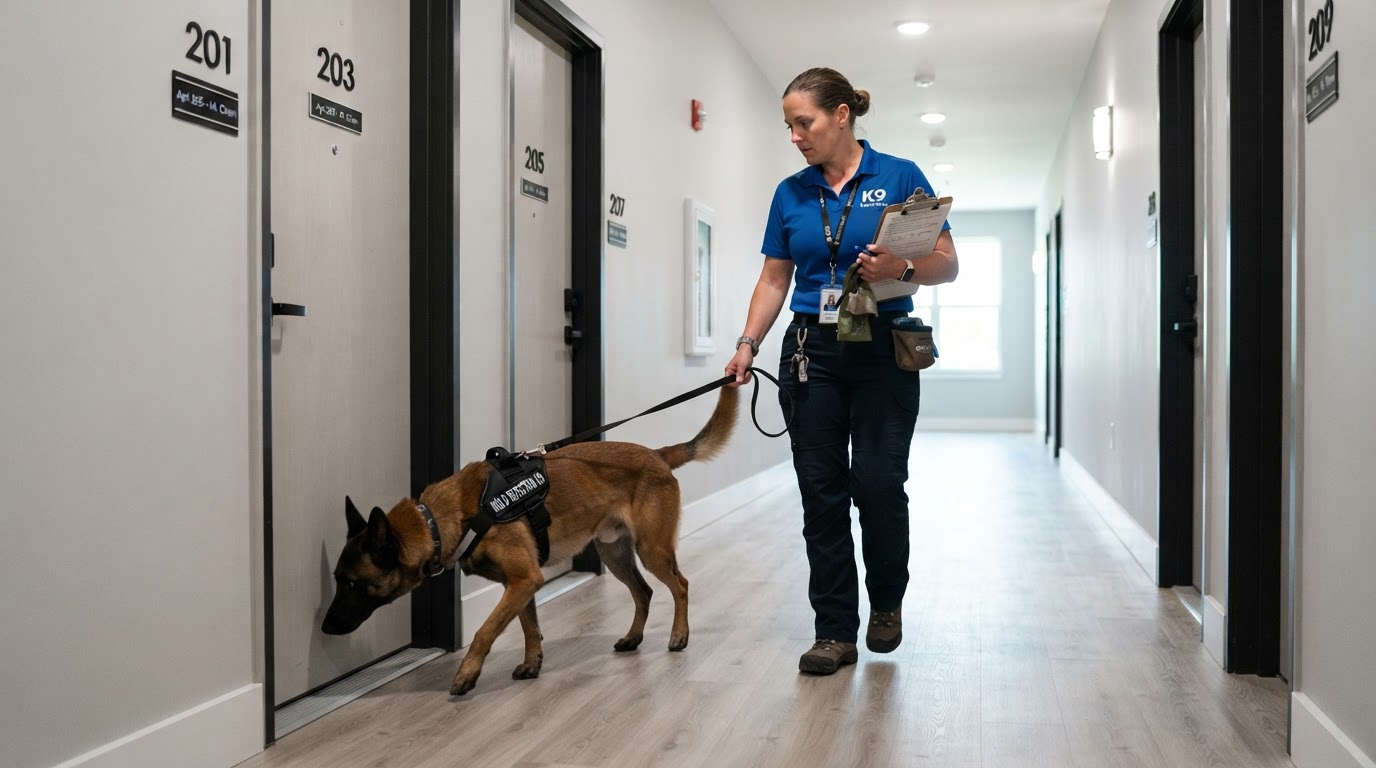
Commercial buildings, offices, and multi-tenant properties. Annually as a baseline, with additional visits tied to any water event. The EPA's guide for schools and commercial buildings observes that "delayed maintenance or insufficient maintenance are also associated with moisture problems in schools and large buildings," which is a polite way of saying that the buildings with the least attention develop the most expensive problems.
Properties where somebody in the household is sensitive to damp indoor environments. Recurring monitoring, at an interval you set with your physician's input rather than ours. We can tell you what we found in the areas we inspected. We are not the right people to tell you what that means for anyone's health.
If you are weighing a recurring plan against booking visits one at a time, our monthly residential and commercial monitoring page lays out how the recurring version is structured.
What Recurring Monitoring Actually Buys You
The value of monitoring is not that it finds more mold. It is that it shortens the gap between a problem starting and somebody knowing about it.
A one-off inspection tells you the condition of the building on one day. That is genuinely useful when you have a specific question. It is much less useful as a risk strategy, because the thing you are trying to avoid is not "mold exists somewhere." It is "mold grew for eight months behind a wall while the building was under our management and nobody looked."
Monitoring also builds something a single visit cannot: a record. If a tenant raises a concern, a dated series of inspection reports is a very different conversation than a promise that you have always been careful. If an insurer asks when a problem started, the record narrows the window. Property managers tend to value this part more than the detection itself, and they are not wrong to.
Request a recurring monitoring plan and we will scope an interval to the property rather than to a price list.

What Snow and Otis Add, and What They Do Not
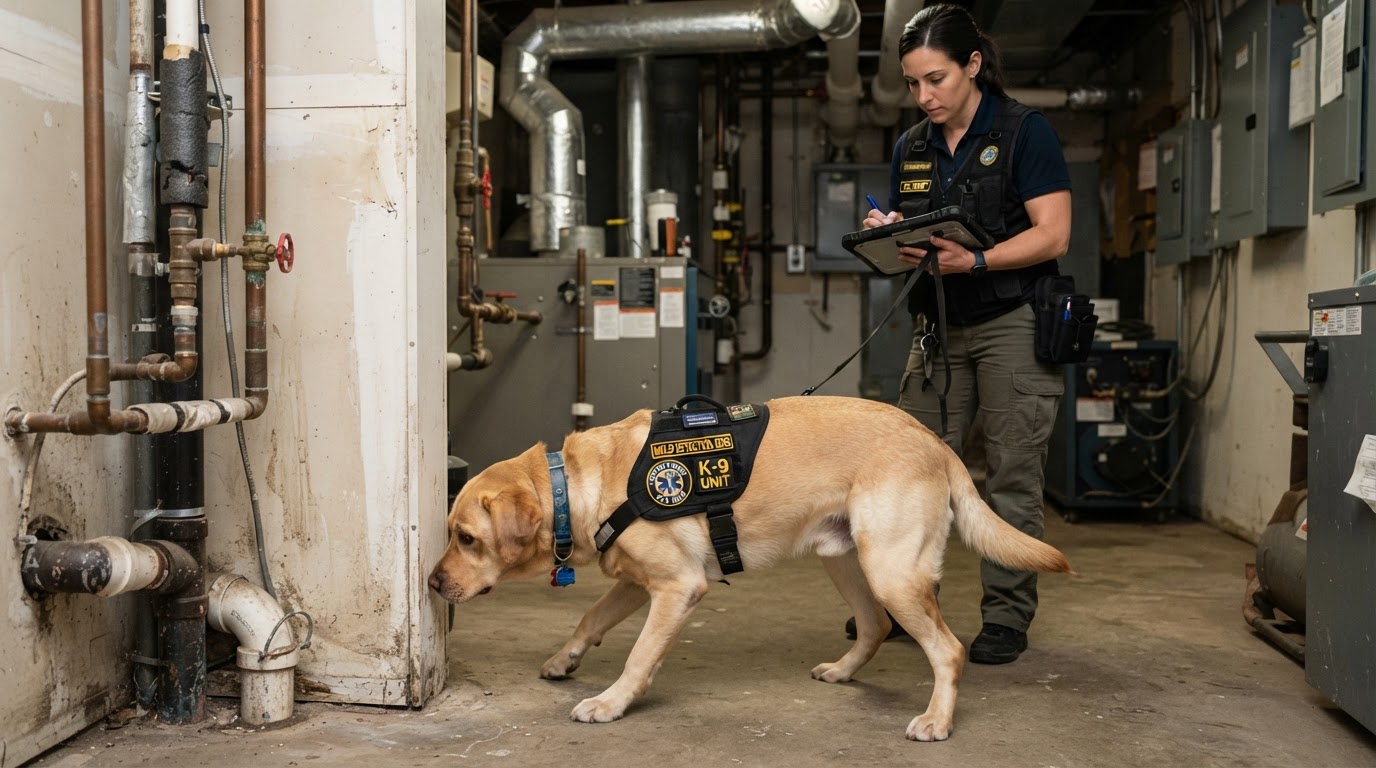
Our inspections are led by Hadi Ali and Sage Ali working with Snow and Otis, two dogs trained to detect the scent of active mold growth, including in places a visual inspection cannot reach without opening them up. Behind walls. Under flooring. Inside HVAC runs. That reach is the reason canine detection fits recurring work well: a dog can cover a whole building quickly and repeatedly without anyone cutting into it.
The dogs are certified as a handler and dog team through Rival K9's program, trained by a former police K9 handler certified through the Utah P.O.S.T. K-9 Program.
Now the limits, plainly. A canine alert indicates that the scent of active mold growth is present in an area. It does not tell you what species is there. Species identification requires laboratory analysis, and anyone who tells you a dog can name the mold is describing something dogs do not do. No detection method is perfect, and an alert is a strong reason to confirm with testing rather than a finding on its own.
We also do not remediate. We do not sell removal, we do not partner on removal jobs, and we have no financial reason to find mold in your building. When we tell you we found nothing in the areas we inspected, that is worth something precisely because the finding costs us the follow-on work.
Walla Walla Valley and Tri-Cities Properties
Two local patterns shape how often inspections make sense here.
The first is the hospitality and wine-tourism economy. Walla Walla is the county seat of a region with a heavy visitor season, and a lot of local property is either short-term rental stock or commercial space that fills and empties on a seasonal rhythm. Buildings that sit closed between busy periods carry a different risk profile than buildings occupied year round, and they are the clearest candidates for a quarterly or seasonal interval rather than an annual one.
The second is the spread of the service area. We work routinely across Walla Walla, College Place, Waitsburg, Dayton, Prescott, and Dixie, and out into Burbank, Pasco, Kennewick, and Richland. Owners with more than one property in that footprint often find that scheduling those properties together on one recurring visit is simpler than booking each one reactively. If you want the local detail, our Walla Walla service area page covers what we cover.
If you are inspecting a single home for a specific reason rather than setting up a program, residential canine mold inspection is the page you want instead.
When You Should Skip the Inspection Entirely
Two situations, and we would rather say them out loud.
If you can already see mold growing, testing to prove it is there is usually wasted money. The EPA is direct about this: "In most cases, if visible mold growth is present, sampling is unnecessary." Find the water, fix the water, clean up what is there or hire someone to. An inspection is worth booking when you suspect something you cannot see, or when you need documentation.
And if you just had water intrusion and you are inside the 24 to 48 hour window, your money is better spent on drying equipment right now than on an inspection this week. Dry it properly. Then, if you are unsure it dried completely, that is exactly the right moment to have somebody look. Our post on what to do after water damage walks through that sequence.
Setting Your Interval
Pick the trigger list first and make sure everyone who would notice a problem knows to call. Then, if your property is tenanted, unoccupied for stretches, commercial, or carries a water history, put a recurring interval behind it.
If you want to know what a single visit runs before you think about a program, our mold inspection cost breakdown covers that.
Otherwise: request a recurring monitoring plan for your property, and we will recommend an interval based on the building, not on a subscription tier. If you manage several properties, ask about commercial monitoring and we will scope them together.
*Sources: U.S. EPA: A Brief Guide to Mold, Moisture and Your Home | U.S. EPA: Mold Testing or Sampling | U.S. EPA: Mold Remediation in Schools and Commercial Buildings*
Frequently Asked Questions
Suspect Mold in Your Home or Property?
Schedule a non-invasive canine mold inspection with our K9 handlers today. Serving Walla Walla and Eastern Washington.
Related Articles
Mold Inspection for Property Managers: A Practical Checklist
Mold inspection for property managers, as a checklist: seasonal checks, tenant complaint steps, and when scheduled monitoring is worth it.
Which Mold Test Do You Need? Surface, Air, and Mycotoxin Testing Compared
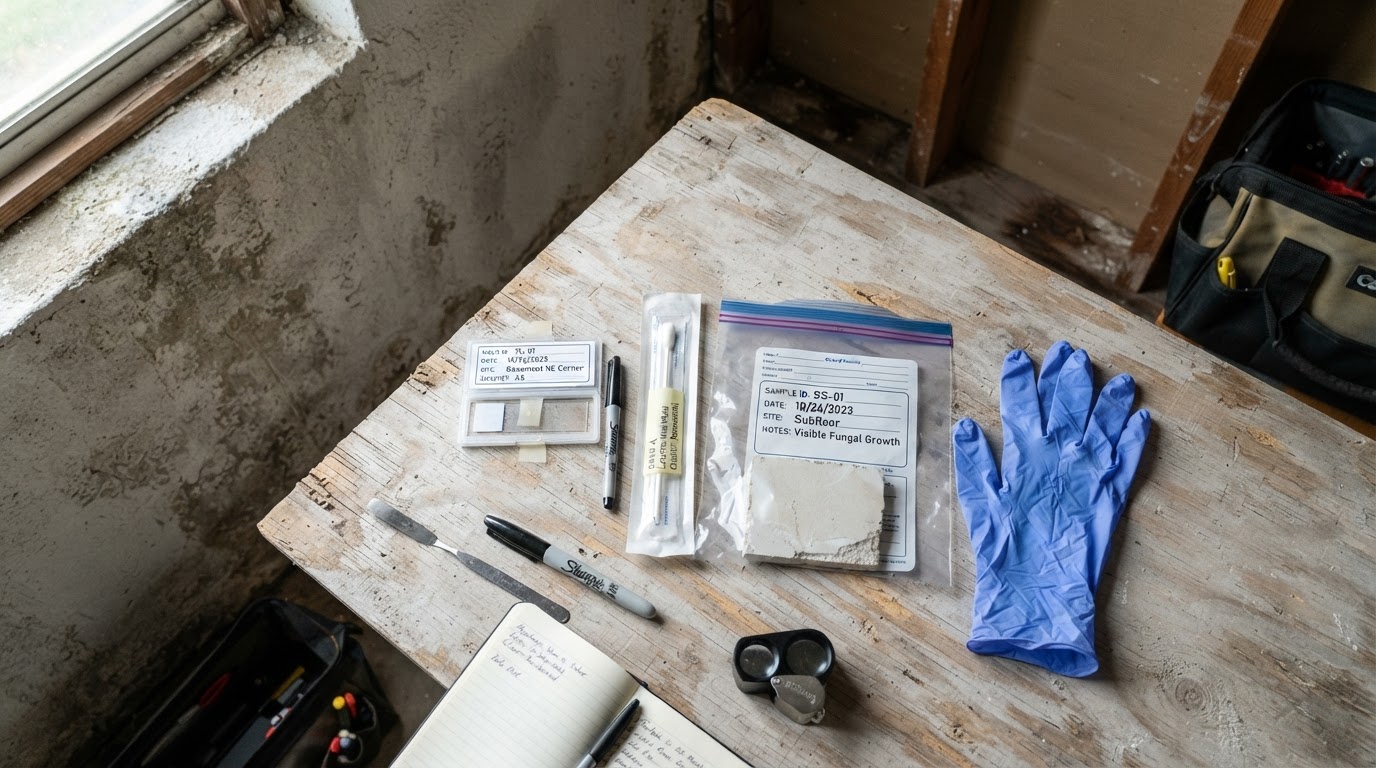
Which mold test do you need? Compare surface testing, air sampling, and building mycotoxin testing, and learn when testing is not necessary.