Why a Mold Inspection Before Remediation Comes First
You have two quotes on the table. One says open the whole wall. The other says open a section of it. They are within a few hundred dollars of each other, and neither contractor can tell you how far the problem actually goes, because nobody has looked inside yet.
A mold inspection before remediation exists to solve exactly that. It maps the boundary of the problem before anyone starts cutting, so the scope in the bid is a measurement rather than an estimate. That single change does more to control the cost of a mold job than anything else available to you.
Here is what pre-remediation mapping is, why the sequence matters, and when you can skip it.
The scoping problem nobody names out loud
Remediation contractors are not guessing because they are careless. They are guessing because the information does not exist yet.
Mold grows in cavities. The visible stain on the drywall is the part that surfaced, not the extent of the growth, and the only conventional way to find the boundary is to open the wall progressively until the material comes back clean. That is a reasonable method, and the EPA's own remediation planning guidance treats defining the extent of the problem as a step that precedes the cleanup. It is also a method that discovers the answer by destroying the thing it is measuring, and it produces two predictable outcomes.
Over-scoping is the first. Faced with an unknown, a careful contractor bids for the larger area, because coming back for a second phase is worse for everyone. You pay for demolition, disposal, and reconstruction of material that may not have needed to come out.
Under-scoping is the second, and it is worse. The crew stops at the edge of what was visible, the wall goes back up, and the growth that continued along the joist bay is now behind new drywall.
Neither is a contractor problem. It is an information problem, and it is solvable before the bidding starts.
What a mold inspection before remediation actually produces
A pre-remediation canine mold inspection is a mapping exercise, not a second opinion on whether you have mold.
It covers:
- •A full scent sweep of the affected area plus adjacent rooms and corridors, since water travels and growth follows it
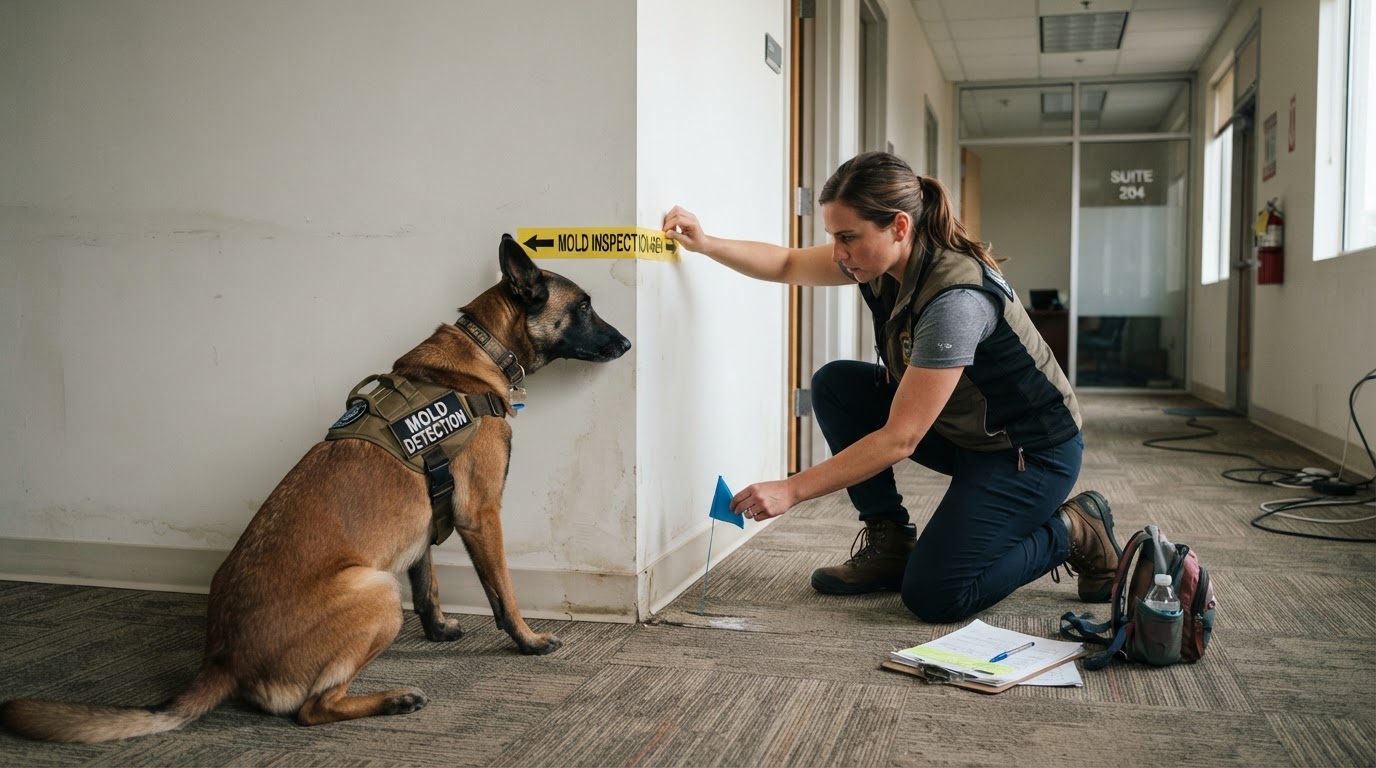
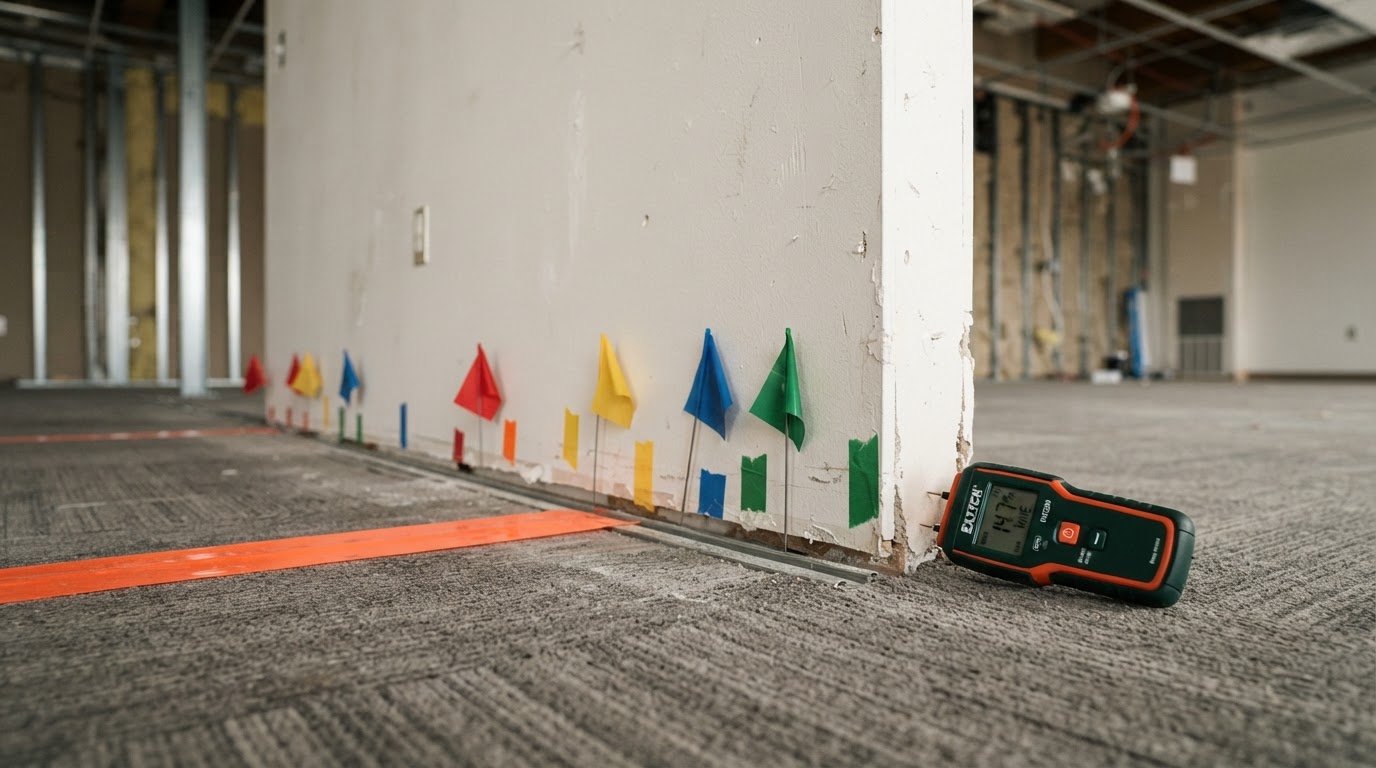
- •Physical marking of each alert location so the remediation crew can see the boundary rather than read about it
- •Thermal imaging and moisture meter readings at each alert, confirming whether the area is still wet
- •A written containment scope map with measurements and photographs
- •A check for secondary clusters along HVAC runs and water pathways, which is where the expensive surprises usually hide
- •Direct consultation with your remediation contractor to walk the findings before demolition begins
The output is a document a contractor can bid against. Rather than "the wall in the back bedroom," the scope becomes a mapped perimeter with dimensions, which is why contractors generally welcome it. Quotes built against a defined scope are easier to defend and easier to compare.
Why the order matters: map first, then bid
The most common sequencing mistake is getting quotes first and mapping second, or mapping not at all.
Get the map first. A contractor bidding on a measured perimeter is bidding on the same job as the next contractor, which is the only condition under which comparing two quotes tells you anything. Bidding on an undefined area means the difference between two numbers may be a difference in assumptions rather than in price.
There is a second reason, and it is the one most people care about after the fact: reducing demolition from an entire wall to a targeted section reduces the demolition itself, the disposal, and the reconstruction that follows. Three costs, not one.
Schedule pre-remediation mapping before you accept a bid, not after.
Should the company that tests also do the removal?
This question comes up constantly and it deserves a straight answer rather than a sales one.
There is a structural conflict when one company both determines how much mold you have and gets paid to remove it. That does not make every combined provider dishonest, and many do good work. It does mean the incentive runs one direction, and you have no easy way to check the scope against anything.
Canine Scent Inspections does not perform remediation. There is no demolition crew, no disposal fee, and no reconstruction bid attached to any finding. When the map comes back smaller than expected, that is simply the result.
Hadi Ali, who is certified through Rival K9's Mold Detection Dog Program and handles both dogs, works the mapping with Otis on concealed drywall and subfloor problems and with Snow on larger or more complex commercial layouts. Sage Ali coordinates the sampling and the contractor handoff. The deliverable is the map and the consultation, and that is the whole business model.

What canine mapping adds, and what it does not
The reason a dog is useful at this specific step is that the sweep is non destructive. No holes are cut, no walls are opened, and no furniture is disturbed, which means the boundary can be marked before any demolition decision is made rather than discovered during it.
What it does not do is tell you what is growing there. An alert indicates that odor associated with active mold growth is present in an area. It does not identify the species or the quantity, and it is not a substitute for laboratory analysis. If your contractor, insurer, or lender needs a species identification, surface testing for mold is the step that provides it, typically returning results in 5 to 7 business days.
No detection method is perfect. A mapped perimeter is a substantially better starting point than a stain on the drywall, and it is still a starting point that gets confirmed as the work proceeds.
When you can skip this step
Not every job needs mapping, and it is worth saying so.
The EPA's guidance for homeowners is that a moldy area smaller than roughly 10 square feet, with a cause you have identified and corrected, can usually be handled without professional involvement. Surface growth on bathroom tile after a fan failure does not need a containment scope map.
You can also reasonably skip it when the affected assembly is coming out regardless for another reason, such as a bathroom already scheduled for a full gut, or when the material is a small, discrete, fully exposed item like a section of baseboard you can lift and see behind.
Mapping earns its cost when the growth is concealed, when the affected area crosses into a cavity or an adjacent room, when an insurance claim or a lease dispute is attached, when the property is transacting, or when you are choosing between quotes that differ in scope rather than in price.
If your situation falls in the first group, you will be told that on the phone rather than sold an inspection.
Planning around a remediation schedule locally
Contractors in the Walla Walla Valley and the Tri-Cities book out, and mold work usually arrives on an unplanned schedule, so timing is the practical constraint.
Inspections are typically accommodated within 48 to 72 hours, and for urgent situations same-day or next-day dispatch is often available. Evening, weekend, and holiday scheduling comes at no additional cost, which matters when a commercial space cannot lose operating hours to a mapping visit. Travel within Walla Walla, Columbia, Franklin, and Benton Counties is included in standard rates.
Coverage runs across Walla Walla, Dixie, Prescott, Waitsburg, Dayton, and Burbank, and into Pasco, Richland, Kennewick, Finley, Selah, and Eureka.
If you are trying to build a budget before you commit to anything, the breakdown of what a mold inspection costs is the place to start.
Close the loop afterward
Mapping before is half of it. The other half is verification after.
Once the cleanup is finished and the containment equipment is out, a post-remediation canine mold inspection confirms whether active mold odor remains in the areas that were treated, typically 24 to 48 hours after the work wraps and before reconstruction begins. The same independence applies: there is no follow on work riding on the answer.
Your next step
If you have quotes in hand and they disagree about scope, that disagreement is the reason to map.
Schedule pre-remediation mapping before you sign anything, or call for an urgent inspection if a crew is already scheduled and you need the boundary marked first.
*Sources: U.S. EPA, A Brief Guide to Mold, Moisture and Your Home | U.S. EPA, Mold Remediation in Schools and Commercial Buildings Guide, Chapter 1*
Frequently Asked Questions
Suspect Mold in Your Home or Property?
Schedule a non-invasive canine mold inspection with our K9 handlers today. Serving Walla Walla and Eastern Washington.
Related Articles
Mold Inspection for Property Managers: A Practical Checklist
Mold inspection for property managers, as a checklist: seasonal checks, tenant complaint steps, and when scheduled monitoring is worth it.
Which Mold Test Do You Need? Surface, Air, and Mycotoxin Testing Compared
Which mold test do you need? Compare surface testing, air sampling, and building mycotoxin testing, and learn when testing is not necessary.