What Happens After a Mold Dog Alerts?
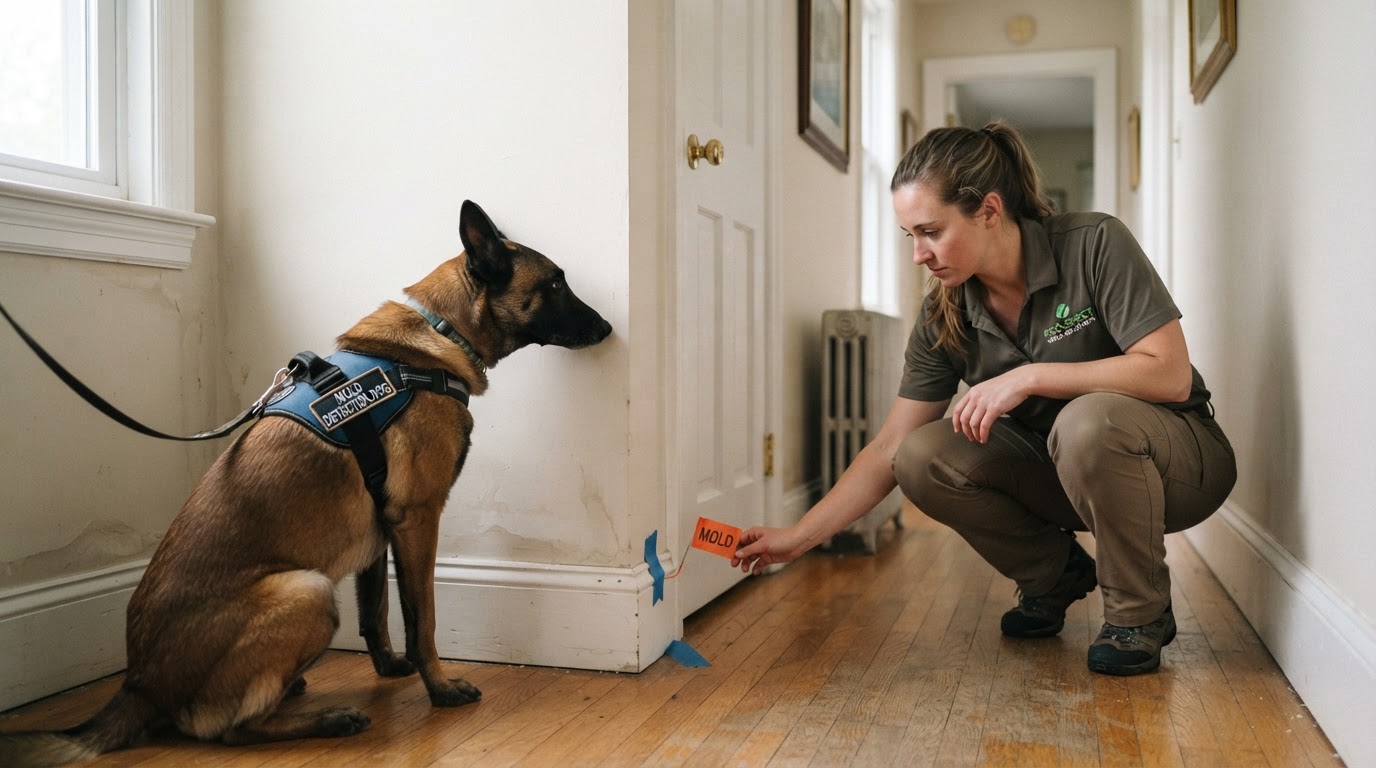
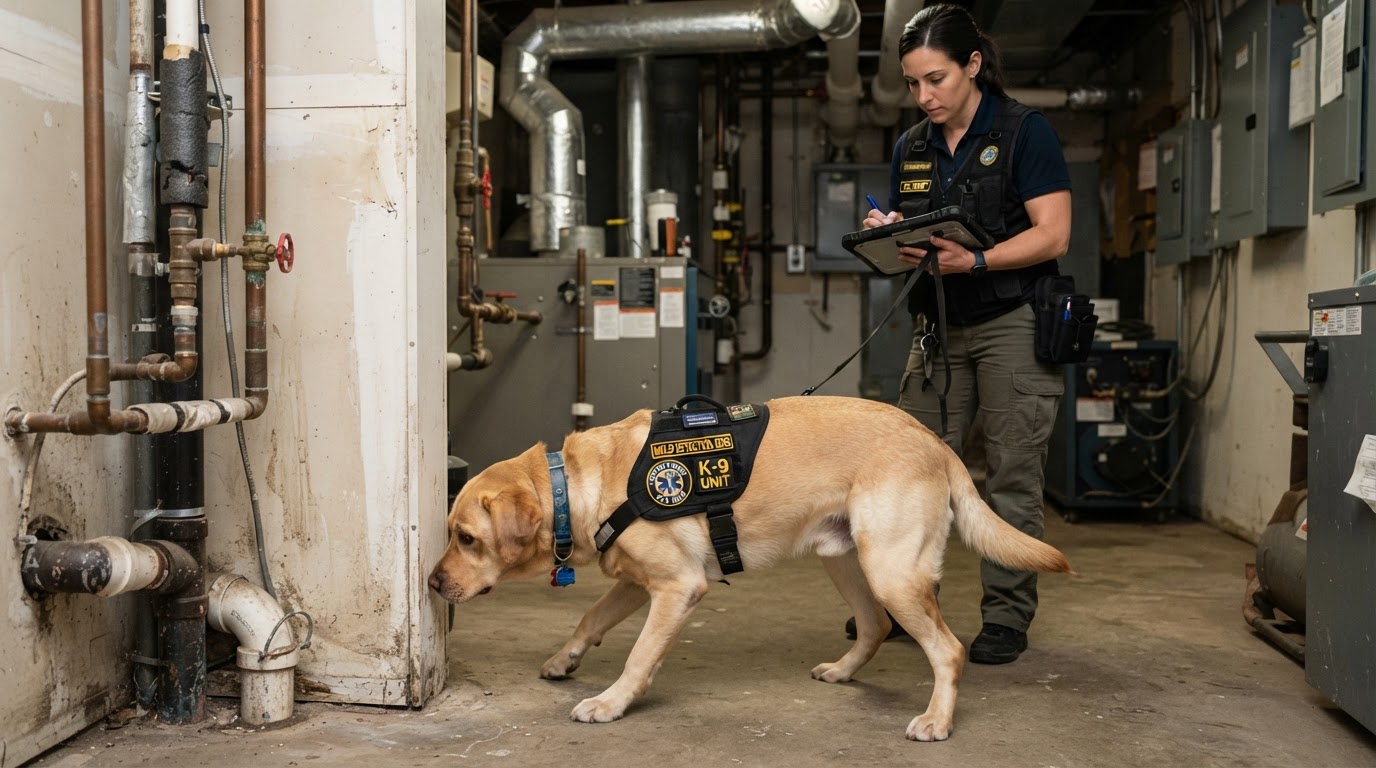
The dog stops in the hallway, works back along the baseboard, sits, and holds its nose at one spot. The handler marks the location and moves on. Nothing has been opened, nothing has been cut, and you are standing there with a question nobody has answered yet.
What happens after a mold dog alerts is the part most people have not thought through before booking a residential canine mold inspection, and it matters more than the alert itself. An alert is a starting point. It tells you where to look. The decisions that follow determine whether you spend money well or spend it guessing.
Here is the honest sequence, including the parts where the answer is that you may not need to do anything at all.
What a canine alert actually means
A trained detection dog works from scent, not sight. It is trained to indicate the odor associated with active mold growth, which travels through wall cavities, along floor assemblies, and out of air registers. That is why a dog can indicate a source behind a finished surface without anyone opening it.
An alert means the dog indicated that odor at that location. It is a strong signal that the spot deserves a closer look.
It is not a lab result, and it is not a diagnosis. A canine alert does not identify a species of mold, does not measure how much is present, and does not say anything about anyone's health. Any company that tells you otherwise is describing something a dog cannot do. If you have not yet decided whether canine detection is the right starting point for your property, how canine detection compares to a traditional inspection walks through the difference.
What happens in the next few minutes of the inspection
The alert is not the end of the visit. At each marked location, the inspection continues on the spot.
The handler does a visual check of the area for staining, warping, or discoloration. A moisture meter goes on the surface to see whether conditions there still support growth. Thermal imaging may come in as well, depending on the building and the alert, since temperature differences can show where water has traveled.
That combination is what turns a scent indication into something usable. A dog alert plus elevated moisture plus a visible tide line on the drywall is a very different piece of information from an alert in a dry wall cavity with no other evidence. Both are worth recording. They point toward different next steps.
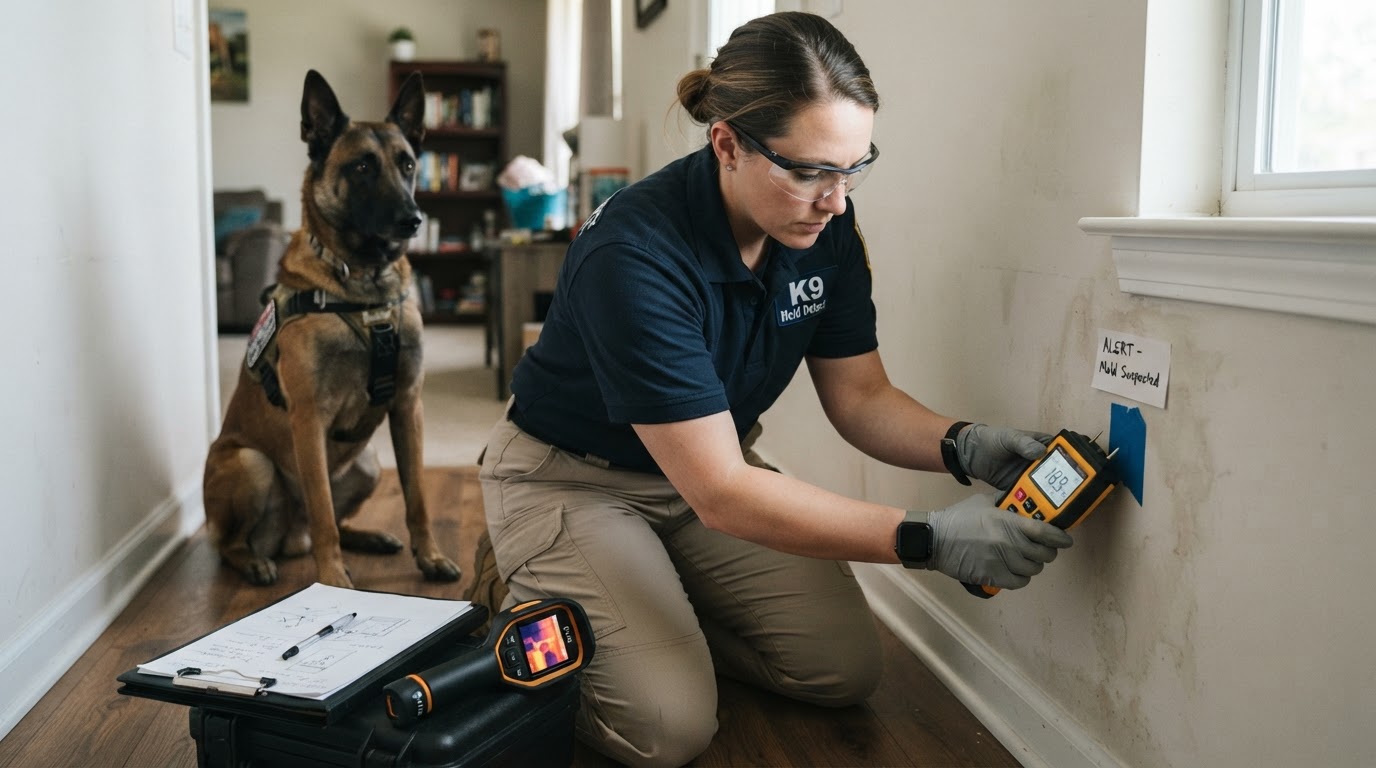
You should expect the handler to tell you what they are using and why as they go. If a tool is not being used on your property, there is usually a reason, and you are entitled to hear it.
What you get at the end, and what happens after a mold dog alerts
Your report covers the areas that were inspected, every location where a dog alerted, moisture readings, photos, and recommended next steps. For commercial and multi-tenant buildings, alert locations are mapped to the floor plan.
From there, there are only three real paths.
Confirmation testing. A sample is collected at or near the alert location and sent to an independent laboratory. This is the route when you need to know what is actually there before anyone spends money on demolition or remediation.
Investigate the assembly. Sometimes the sensible step is a targeted opening at one alert location rather than a lab sample, because the question is not what is growing but how far the water went. That work belongs to a contractor, not to an inspection company.
Monitor and fix the moisture. If the alert sits in an area with a known, correctable moisture source and no other evidence of a problem, the reasonable answer can be to correct the source and re-check later. Mold needs moisture. Take the moisture away and you have addressed the cause rather than the symptom.
Which of the three fits your property depends on the alert, the building, and what you actually need to decide. That conversation is part of the debrief.
If you already have a report with alert locations in it and you are trying to decide what to do next, schedule surface testing at the alert locations or call and talk it through first. There is no charge for asking which of the three paths fits.
Do you need lab testing after a canine alert?
Not always, and this is worth being clear about because it is where people overspend.
The U.S. Environmental Protection Agency's position is that in most cases, if visible mold growth is present, sampling is unnecessary. If a dog alerts, the wall is opened, and there is obvious growth in front of you, paying a lab to confirm that mold is mold rarely changes what you do next. The EPA also notes there are no federal standards for mold or spore levels, so a test result cannot be measured against a legal limit. The CDC and NIOSH make the same point, and add that they do not recommend routine air sampling as part of general building evaluations.
Testing earns its cost when it answers a question you genuinely have:
- •You need documentation for an insurance claim, a lease dispute, or a real estate negotiation
- •You need to know whether a previous remediation actually achieved its goal
- •Something is growing in a place where the material matters, and a contractor wants to know what they are dealing with before scoping the work
- •You want a baseline before starting a monitoring program
If none of those apply to you, say so out loud when you get your report. A recommendation to test should come with a reason attached to your situation.
The testing options, and what each one answers
These are different services answering different questions. They are not interchangeable, and mixing up the terms is how people end up with a result that does not tell them what they wanted to know.
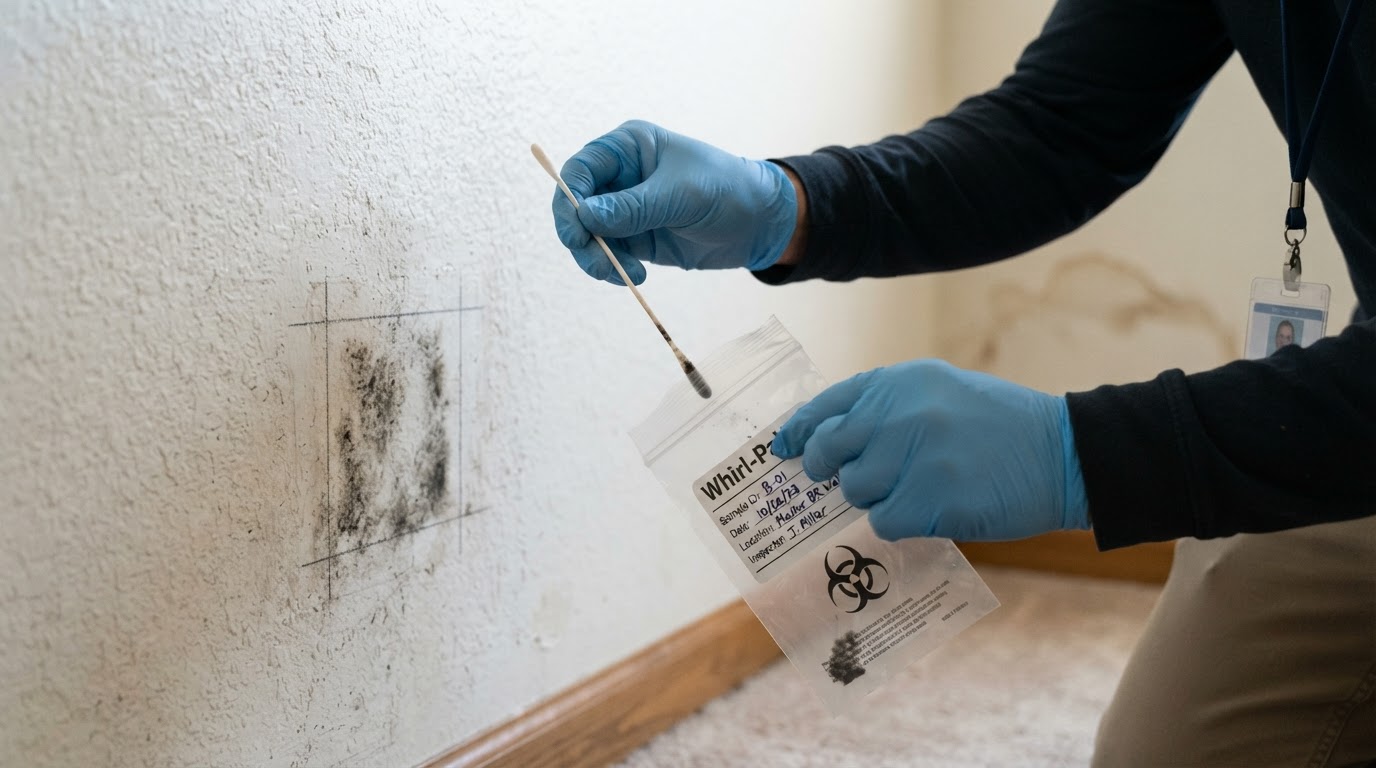
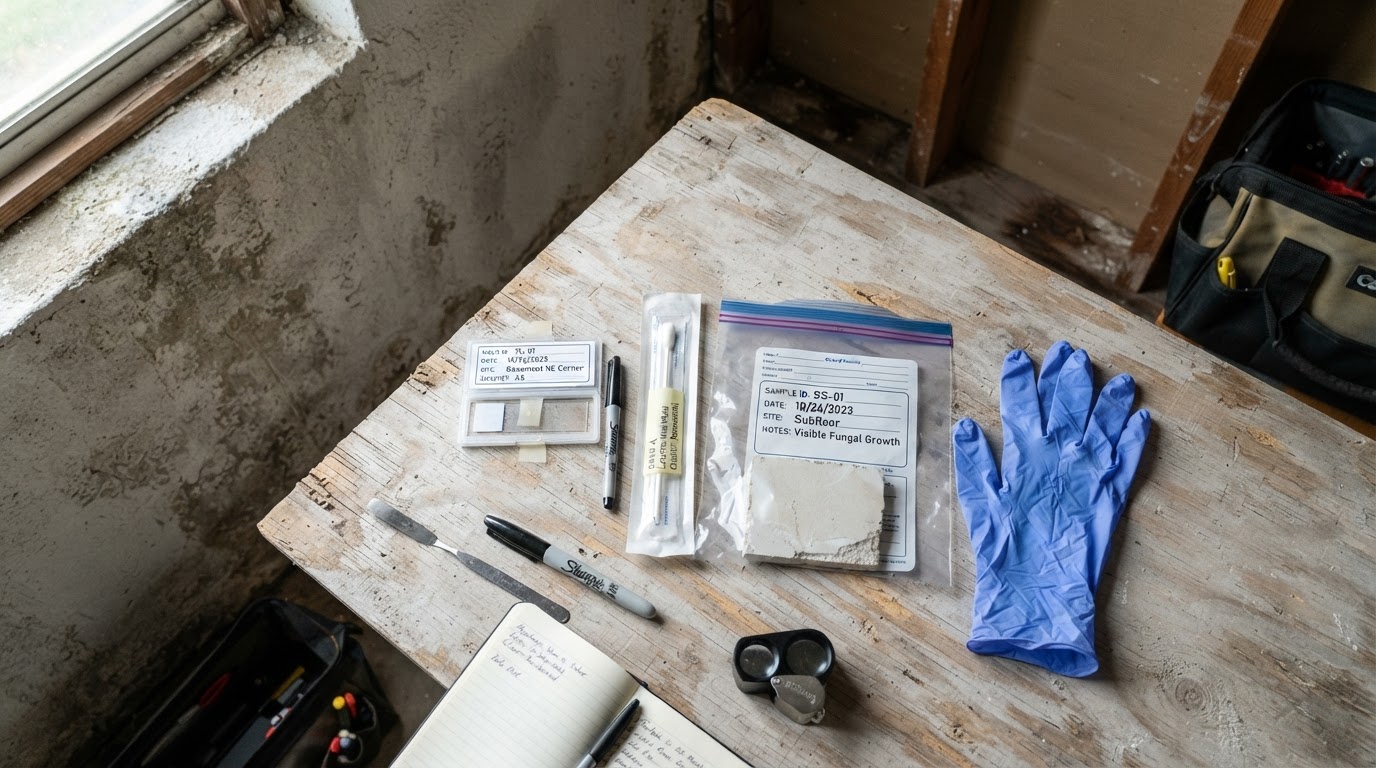
Surface testing (swab or tape lift). A sample taken directly from a surface, analyzed by a laboratory. This answers what is growing at that specific spot. Results typically take five to seven business days.
Air sampling. Measures airborne spores during the window the pump was running. Useful in specific situations, and limited by the fact that a colony sealed inside a wall cavity may not be shedding much into the room air, which is precisely why the dog was needed in the first place. Why air tests miss mold behind drywall covers that limitation in detail.
EMMA environmental mold and mycotoxin assessment. A dust-based analysis covering ten mold species and sixteen mycotoxins, which gives a cumulative picture of the building over time rather than a snapshot of one moment. Mycotoxins are compounds that certain molds produce, and they can persist in a building after growth has been removed. Results typically take ten to fourteen business days.
Your report and your reason for testing should determine which one you order. If you are working against a closing date or an insurance deadline, say that at the start, because the turnaround times are not the same.
What if the dogs do not alert anywhere?
That happens, and it is a useful result rather than a wasted visit.
What the report can say is that no mold odor was detected in the areas the dogs were able to access, along with the moisture readings taken during the visit. What it cannot say is that a building is mold free or safe, and nobody should be handing you a document that claims either. Areas the dogs could not reach are areas the dogs could not reach, and an honest report lists them.
For a lot of property owners, that is exactly what they were paying for: a documented answer to a question that had been sitting unresolved for months.
Where the Walla Walla Valley part comes in
Snow and Otis work throughout the Walla Walla Valley and into the Tri-Cities, which means the same inspection covers properties in Walla Walla, College Place, Waitsburg, Dayton, Dixie, Prescott, and across into Burbank, Pasco, Richland, and Kennewick. Travel within Walla Walla, Columbia, Franklin, and Benton Counties is included in the inspection. For the full coverage detail, see our mold inspection in Walla Walla page.
That matters for the post-alert stage more than people expect. If confirmation testing or a re-check is likely, you want the team that documented the original alert locations to be the team that can get back out to them without a travel charge and without re-establishing where everything was.
Ready to move from an alert to an answer? Schedule testing at your alert locations, or ask which of the three paths above fits your property before you commit to anything.
The short version
A canine alert narrows down where to look. Lab testing identifies what is there. A contractor opens the assembly and fixes it. Those are three separate jobs, and Canine Scent Inspections does the first two and not the third, which is the reason a recommendation to test comes with a reason rather than a sales pitch.
If you have a report in hand and no clear next step, that is the call to make. Bring the report to the conversation.
*Sources: U.S. EPA: Mold Testing or Sampling | CDC / NIOSH: Mold Testing and Remediation*
Frequently Asked Questions
Suspect Mold in Your Home or Property?
Schedule a non-invasive canine mold inspection with our K9 handlers today. Serving Walla Walla and Eastern Washington.
Related Articles
Mold Inspection for Property Managers: A Practical Checklist
Mold inspection for property managers, as a checklist: seasonal checks, tenant complaint steps, and when scheduled monitoring is worth it.
Which Mold Test Do You Need? Surface, Air, and Mycotoxin Testing Compared
Which mold test do you need? Compare surface testing, air sampling, and building mycotoxin testing, and learn when testing is not necessary.